

Executive Summary
Vail Health’s Vail Valley Surgery Center faced significant operational and revenue cycle challenges with their legacy ASC transcription service. Operative reports took up to 7 days to complete, came back with blanks requiring physician corrections, and generated frequent coding queries that delayed billing anywhere from 48 hours to a week.
After implementing DocBuddy Op Note, Vail Health achieved dramatic improvements: average operative report completion time plummeted from 5-7 days with transcription to 24-48 hours with DocBuddy. Coding queries virtually disappeared and the revenue cycle team gained real-time visibility into documentation status.
The result: a faster revenue cycle, optimized staff utilization, and better physician quality of life.
Key Takeaways
After Vail Health made the switch from the legacy ASC transcription service they’d been using, the positive impact DocBuddy Op Note delivered to the organization was immediate.
DocBuddy Op Note delivered:
-
- 80% reduction in operative report completion time.
- Near-elimination of coding queries.
- Consistency in achieving the organization’s days-to-bill revenue cycle metric.
The Challenge: ASC Transcription Services’ Hidden Costs
The Old Way: Voice-to-Transcriptionist-to-Physician
Vail Health’s legacy transcription service followed the traditional model: physicians called a 1-800 number or used an app to record their operative reports, which were then transcribed by human transcriptionists and returned for physician review and signature.
While this process was familiar, it created significant operational friction:
Timeliness Problems
The human transcription step added substantial delays to report completion. Vail Health’s HIM Operations Manager and Interim Revenue Cycle Director, Irina Tenorio, explained: “It takes slightly longer for the operative reports to come back from Transcription because of the human factor to transcribe an operative report and then for the physician to go back and review.”
The impact was measurable. Physicians routinely took 5-7 days just to complete the initial operative report—not even to sign it. With Vail Health’s target of 3-5 business days from surgery to claim submission, even a 24-hour delay represented a 33% increase in their days-to-bill metric.
“Even at the low end, for three days, that’s 33%,” Irina noted when discussing the revenue cycle impact.
Quality and Accuracy Issues
Legacy transcription reports frequently returned with blanks—gaps where the transcriptionist couldn’t understand the physician’s dictation due to recording quality, accents, or medical terminology. This created a cascading problem:
“Unfortunately, we’re seeing a lot of blanks,” Irina explained. “Physicians have to go back and review, fill in all the blanks, and then sign off on the report.”
When reports were incomplete or contained errors, the coding team had to initiate query cycles to get clarification. This added anywhere from 48 hours to 7 days to the billing process.
“If we have an incomplete operative report, we have to notify the provider. How often do they look at their emails? How quick does the phone call or voicemail from the office manager get to the provider? You have to account for the communication with the provider… and then when they will act on that, because they already have another caseload of charts that they need to dictate.”
Operational Blind Spots
Perhaps most frustrating for the Vail Health team was the complete lack of real-time visibility. “The charge nurse running the department and the OR manager with the old way (transcription) didn’t know at three o’clock in the afternoon if all 15 cases were dictated,” Aaron Bohannon, VP of Business Operations at Vail Health, explained. “They could see the physician on the phone, they could see him talking and doing something” but had no way to verify actual completion status.
Template Management Challenges
While ASC transcription services can support templates, they are difficult to manage and update. Templates were typically physician-specific rather than specialty-wide, requiring each surgeon to maintain their own documentation source.
“In the transcription world, if they pick up the phone, unless they have those templates in front of them from their own source, they won’t have it. They’ll just have to rely on their memory,” Irina noted. “We have physicians with over 200 templates.”
Manual Workflow Burden
Vail Health’s HIM team had to manually upload each operative report into the legal medical record system—printing, scanning, and filing documents one by one. This manual process not only consumed staff time but also introduced the risk of human error.
“Putting patient records into the wrong chart—that’s another instance,” Irina explained. “Anything that’s an electronic workflow definitely eliminates those potential human mistakes.”
Revenue Cycle Impact
Most telling was Irina’s assessment of where coding problems originated: “Right now we’re still using a legacy transcription-driven platform in other areas [across Vail Health], and most of our coding queries are derived from operative reports that were documented using the transcription service.
Honestly, I don’t remember seeing any coding queries from documentation generated with DocBuddy.”
The Solution: DocBuddy Op Note
A Fundamentally Different Approach
DocBuddy Op Note empowers surgeons with Voice Commands and Free Dictation for operative report documentation which eliminates the transcriptionist middleman and puts structured, voice-driven templates directly in the surgeon’s hands.
How Op Note Works
Instead of free-form dictation sent to a transcriptionist, surgeons use DocBuddy Voice Commands to populate pre-built templates that contain all the documentation elements required for compliance, coding accuracy, and clinical completeness.
This seemingly simple change addresses multiple problems simultaneously:
-
- No transcription delay – Reports are generated in real-time as the surgeon speaks.
- No blanks – DocBuddy’s voice recognition technology is highly accurate out of the box and each user’s profile is continuously optimized through AI and Machine Learning. Plus, Voice Command templates provide context, exception based charting, and subjective data capture.
- Built-in revenue cycle capture – Templates include all required documentation elements to ensure the claim is coded to the highest degree of specificity and the capture of all case-specific modifiers.
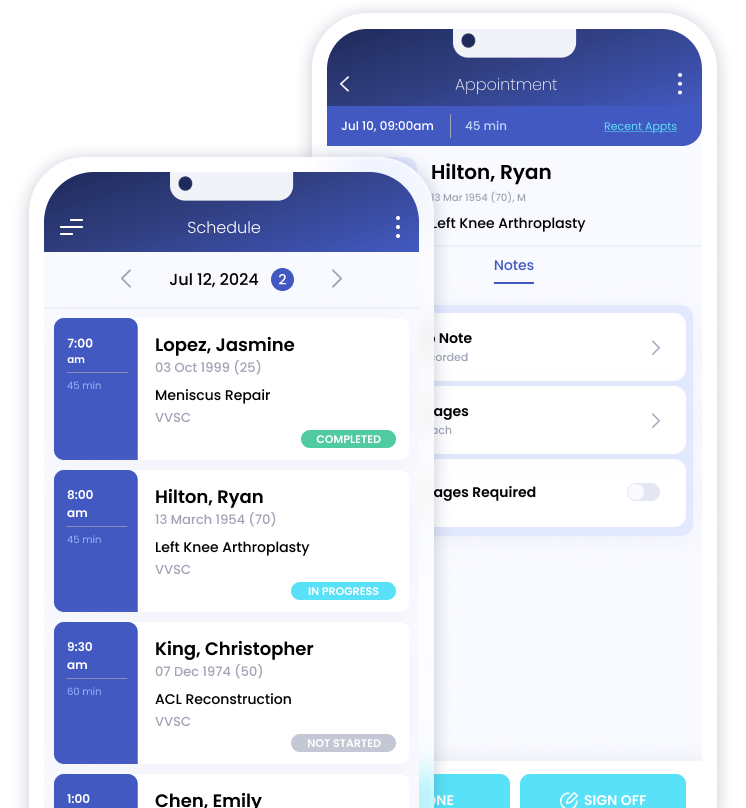
- Visible progress – Managers can log in to see completion status instantly and take action when documentation is delinquent.
Voice Command Template Power and Flexibility
DocBuddy’s Voice Command workflow proved transformational for surgeons. One of the first Vail Health surgeons to implement DocBuddy Op Note, created upwards of 40 templates. Previously a physician who never used templates, he found that templates “cut his time down to almost nothing because he can go in there, preload it, come back in, finish off the variable information directly related to that patient, and then sign off on it.”
For surgeons with complex procedures, templates can be incredibly sophisticated. The Vail Health team recently worked on adding a question to templates about screws placed in multi-hole plates that were then removed—a detail important for accurate coding but easy to forget in free-form dictation.
“It helps the physicians too. They’re there with patients, they’re documenting the operative reports, but they also don’t know all the intricacies of reimbursement,” Irina explained. “This just helps us help them to provide more accurate documentation.”
The Results: Measurable Improvements Across the Board
Dramatic Time Savings
The most striking improvement came in report completion time. The average operative report completion time for surgeons was previously between 5-7 days. Now, surgeons are completing their op reports within 24-48 hours—a reduction of 80% in completion time.
“Most of the operative reports are finalized within 24 or 48 hours. That’s going from a week or even longer to just 24 to 48 hours,” Irina reported. “Our delinquency rate for operative report completion improved dramatically.”
For the process of dictation itself, DocBuddy Op Note users take 1 – 5 minutes to generate complete operative reports, depending on the complexity of the procedure.
Near Elimination of Coding Queries
Perhaps the most significant quality improvement: coding queries have virtually disappeared.
“It’s hard to recall seeing any coding queries from DocBuddy users,” Irina stated. This stands in stark contrast to the legacy ASC transcription service, where “most of our coding queries are coming on operative reports that were previously documented using that platform.”
The elimination of query cycles saves 48 hours to 7 days in the billing process—a massive improvement when the target is 3-5 days from surgery to claim submission.
Real-Time Operational Visibility
OR managers and HIM staff can now see in real-time which cases have been documented and which are still pending. This visibility enables proactive follow-up rather than reactive scrambling at the end of the day or week.
Staff Satisfaction and Efficiency
The HIM team at Vail Health is “super excited” about the electronic workflow that eliminates printing, scanning, and manual uploading of operative reports.
“Less paper, the better,” Irina noted. “Anytime there is one less page to scan, we’re definitely happy.”
Because of DocBuddy’s integration with HST Pathways, Vail Valley Surgery Center’s PM software, completed operative reports are transmitted in real-time into the patients chart once they are finalized by the surgeon.
“My team on the HIM side is super excited to not have to print, scan, upload documents because again, there is margin for error if you’re printing 10, 20 operative reports and then scanning them into the record.”
Revenue Cycle Optimization
Faster, more accurate documentation directly impacts the revenue cycle. Complete reports reach the coding team quicker, coding queries are eliminated, and claims go out the door faster.
“The quicker we have operative reports in the system, the quicker we can send it to the coding team, and the quicker the coding team can code the record and send to the billing team the quicker they can submit the claim for reimbursement,” Irina explained.
Better template-driven documentation also improves coding accuracy and reimbursement. “There are certain procedures, certain diagnoses that need to be mentioned. With DocBuddy, we can build them into the templates and apply them to a whole specialty—all the physicians that we have under one specialty—implementing that one template correction or a whole new template dramatically increase the quality of documentation, and the specificity of the coding, and that equates to stronger reimbursement.”
Support Makes the Difference
Irina emphasized that technology alone doesn’t drive success—responsive support is critical.
“Offering great technology is one thing, but offering great service and support to support this technology is another great element,” she said. “Our Account Manager has been doing a stellar job… having somebody just a phone call away, email away. Once, I was emailing with him and I opened my office door and he was right there!”
The value of face-to-face problem-solving in a remote work world shouldn’t be underestimated: “In the world of remote hybrid work, sometimes this 5-minute face-to-face conversation makes so much difference.”
Conclusion: The ASC Transcription Service Era Is Over
Irina summed up the philosophy driving Vail Health’s transformation: “We don’t want to take humans out of medicine, but operative report generation is a place where you just don’t need humans. If technology can do it better, we can supervise technology, we can verify, we can run audits, but if we can use technology to help us in a daily workflow, we’re all for that.”
Legacy transcription services insert a human bottleneck into a process that DocBuddy’s Op Note solution can handle more quickly, more accurately, and with better outcomes for everyone involved—physicians, staff, coders, billers, and ultimately patients who benefit from the financial health of their healthcare providers.
Vail Health’s results speak for themselves:
- 80% reduction in completion time for problem cases
- Near-elimination of coding queries
- Consistent achievement of 3-5 day billing targets
- Dramatic improvements in staff and physician satisfaction
For surgery centers still relying on legacy ASC transcription services, the question isn’t whether to make the change—it’s how quickly they can implement DocBuddy Op Note.
See DocBuddy In Action
What Customers Are Saying

Dr. Lauren MacTaggert
ORTHOPEDIC SURGEON


Dr. Kavi Sachar
ORTHOPEDIC SURGEON

Jennifer Moore
FNP-BC - LONG TERM CARE

Dr. Sean Griggs
ORTHOPEDIC SURGEON

Dr. Clinkscales
ORTHOPEDIC SURGEON

Dr. Stuart Meyers
ORTHOPEDIC SURGEON

Dr. Eric Britton
ORTHOPEDIC SURGEON