
Ambulatory surgery centers face a critical decision when selecting surgery center transcription services for their documentation needs. Traditional transcription has served the healthcare industry for decades, but modern alternatives are reshaping how ASCs document operative reports, accelerate revenue cycles, and optimize staff workflows. This guide examines both approaches to help surgery center administrators make informed decisions.
What Are Surgery Center Transcription Services?
A surgery center transcription service converts physicians’ dictated operative reports into written documentation. Traditionally, this process involves surgeons calling a phone line or using a dictation app to record their post-procedure notes. Human transcriptionists then listen to these recordings and type them into formatted documents that are returned to the physician for review and signature.
This service handles critical documentation including operative reports, pre-operative and post-operative diagnoses, surgical findings, procedure descriptions, and discharge summaries. For ambulatory surgery centers managing dozens or hundreds of procedures monthly, reliable documentation is essential for billing, compliance, and patient care continuity.
The Traditional Surgery Center Transcription Services Model
Most surgery center transcription service providers follow a standard workflow:
- Physicians dictate notes via telephone, mobile app, or digital recorder
- Audio files are sent to transcriptionists (domestically or offshore)
- Human transcriptionists type the dictated content
- Documents are returned for physician review
- Physicians correct any blanks or errors
- Final reports are signed and submitted to medical records
- Billing staff can then process claims
Common pricing models include per-line charges (often $0.14-$0.16 per 65-character line) or per-report fees (typically $6-$7 per operative report).

The Hidden Challenges of Traditional Surgery Center Transcription Services
While traditional surgery center transcription services have been the industry standard, several operational challenges have become increasingly problematic as ASCs face pressure to accelerate revenue cycles and optimize staffing.
Time Delays Impact Cash Flow
The most significant challenge with traditional surgery center transcription service is time delay. At Vail Health’s Vail Valley Surgery Center, physicians using a legacy transcription service routinely took 5-7 days just to complete initial operative reports. Irina Tenorio, Operations Manager of Health Information Management at Vail Health, explained: “It takes slightly longer for the operative reports to come back from Transcription because of the human factor to transcribe an operative report and then for the physician to go back and review.”
With many ASCs targeting 3-5 business days from surgery to claim submission, even a 24-hour delay represents a 33% increase in days-to-bill metrics. The compounding effect across hundreds of procedures annually creates substantial accounts receivable delays.
Quality Issues: Blanks and Corrections
“Unfortunately, we’re seeing a lot of blanks,” Tenorio noted about their transcription experience. “Physicians have to go back and review, fill in all the blanks, and then sign off on the report.” These blanks occur when transcriptionists cannot understand dictation due to recording quality, accents, or complex medical terminology.
When reports contain errors or incomplete information, coding teams must initiate query cycles—adding anywhere from 48 hours to 7 additional days to the billing process. Tenorio described the cascading delays: “If we have an incomplete operative report, we have to notify the provider. How often do they look at their emails? How quick does the phone call or voicemail from the office manager get to the provider?”
Staff Overhead and Manual Workflows
Beyond direct transcription costs, surgery centers must dedicate staff time to managing the workflow. Medical assistants chase physicians for signatures, follow up on missing information, and manually handle image attachments for operative reports.
For operative reports without images, facilities typically require one full-time Medical Assistant (approximately $40,000 annually). When images are involved, this increases to 1.5 FTEs—adding a Medical Assistant plus half-time nurse coverage (approximately $80,000 annually).
Tenorio’s team experienced this burden: “My team on the HIM side is super excited to not have to print, scan, upload documents because again, there is margin for error if you’re printing 10, 20 operative reports and then scanning them into the record.”
Lack of Real-Time Visibility
Aaron Bohannon, VP of Business Operations at Vail Health, highlighted a critical operational gap: “The charge nurse running the department and the OR manager with the old way (transcription) didn’t know at three o’clock in the afternoon if all 15 cases were dictated. They could see the physician on the phone, they could see him talking and doing something” but had no way to verify actual completion status.
This lack of visibility prevents proactive management and forces reactive scrambling when reports are discovered missing days later.
Total Cost Analysis
When combining direct transcription fees with staff overhead, the true cost of a surgery center transcription service becomes substantial. For a facility with 25 providers performing 750 procedures monthly:
| Cost Component | Without Images | With Images |
| Transcription Service ($6/report) | $54,000/year | $54,000/year |
| Staff FTE Costs | $40,000/year | $80,000/year |
| Total Annual Cost | $94,000/year | $134,000/year |
| Days to Bill | 5-7+ Days | 5-7+ Days |
Beyond Traditional Surgery Center Transcription Services: The Modern Alternative
While surgery centers have historically relied on transcription services, a new category of solution has emerged that fundamentally reimagines operative documentation. Rather than dictating for later transcription, modern platforms enable real-time documentation at the point of care.
How Modern Op Note Documentation Works
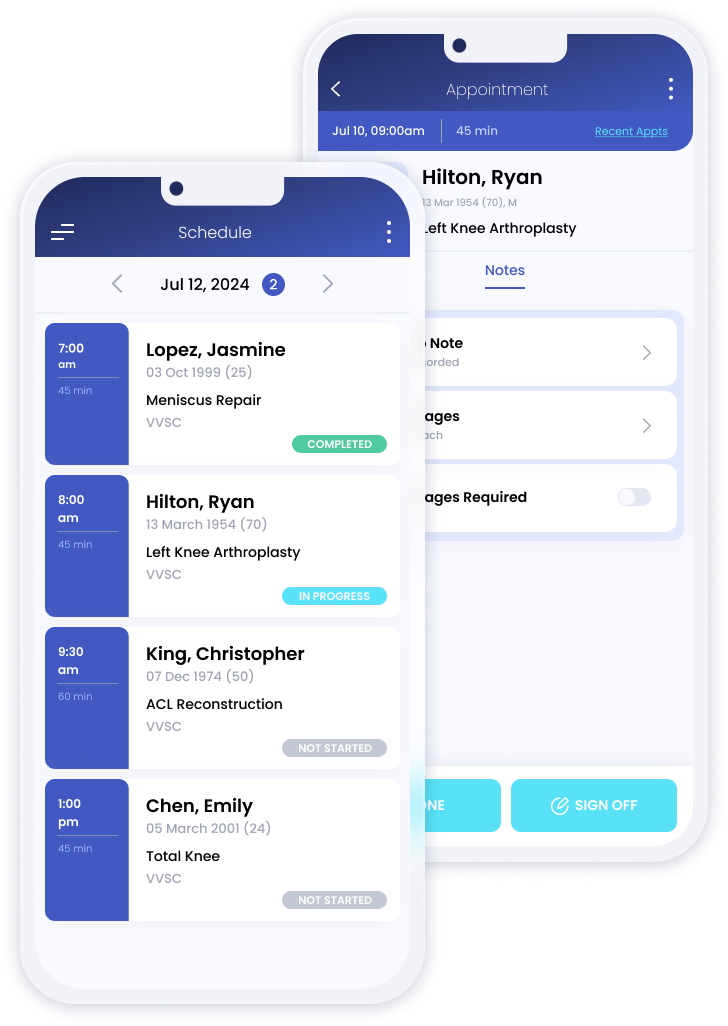
DocBuddy Op Note represents this evolution beyond traditional surgery center transcription services. The platform eliminates the transcriptionist middleman by empowering surgeons with Voice Commands and Free Dictation that populate structured templates directly.
The workflow is fundamentally different:
- Surgeons use mobile devices (iOS/Android) or web portal
- Voice commands populate facility-specific and surgeon-specific templates
- Free dictation captures narrative details and case-specific findings
- Images can be added directly from mobile devices (up to 100 per report)
- Providers sign and approve reports immediately at point of care
- Completed reports flow automatically to billing systems
Documentation takes 1-5 minutes depending on procedure complexity—completed while details are fresh rather than days later.

Real Results: Vail Health Case Study
- 80% reduction in operative report completion time (from 5-7 days to 24-48 hours)
- Near-elimination of coding queries from DocBuddy-generated reports
- 1-5 minutes for surgeons to complete documentation
- Consistent achievement of 3 day billing targets
- Real-time visibility into documentation status
The Technology Difference
Unlike traditional surgery center transcription services that insert a human bottleneck, modern platforms leverage voice recognition technology optimized for medical terminology. The system learns each user’s voice profile through AI and machine learning, improving accuracy over time.
Voice Command templates provide structured documentation while maintaining flexibility. At Vail Health, one surgeon created upwards of 40 templates and found they “cut his time down to almost nothing because he can go in there, preload it, come back in, finish off the variable information directly related to that patient, and then sign off on it.”
Templates can include sophisticated revenue cycle optimization elements. An executive at Vail Health explained: “There are certain procedures, certain diagnoses that need to be mentioned. With DocBuddy, we can build them into the templates and apply them to a whole specialty—all the physicians that we have under one specialty—implementing that one template correction or a whole new template dramatically increase the quality of documentation, and the specificity of the coding, and that equates to stronger reimbursement.”
| Feature | Traditional Transcription Service | Modern Op Note Platform |
|---|---|---|
| Documentation Time | Varies widely | 1-5 minutes per report |
| Time to Completion | 5-7+ days typical | 24-48 hours (80% faster) |
| Quality Issues (Blanks) | Common, require physician correction | None—real-time verification |
| Coding Queries | Frequent source of queries | Near-elimination reported |
| Real-Time Visibility | None | Complete dashboard access |
| Image Management | Manual coordination required | Integrated (100 images/report) |
| Signature Collection | Requires chase and follow-up | Point-of-care approval |
| Staff FTE Requirements | 1-1.5 FTEs for workflow management | None—exception-based only |
| System Integration | Limited | Direct PM/EHR integration |
Key Considerations When Evaluating Surgery Center Transcription Services
Whether maintaining your current surgery center transcription service or exploring alternatives, several factors merit evaluation:
Revenue Cycle Impact
Calculate not just direct transcription costs but the opportunity cost of delayed billing. Every additional day accounts receivable ages represents lost time value of money. Tenorio noted that even at the low end of a 3-day target, “that’s 33%” when a 24-hour delay occurs.
Ask: What is our average time from procedure to claim submission? How much revenue is aging unnecessarily?
Coding Query Frequency
Track what percentage of coding queries originate from operative reports. If most queries stem from documentation created through your surgery center transcription service, this indicates a systematic quality issue. Each query cycle adds 48 hours to 7 days to your billing timeline.
True Total Cost
Include staff time spent chasing signatures, correcting blanks, managing images, coordinating with transcription services, and processing addendums. Many surgery centers discover their actual costs are 50-100% higher than apparent transcription fees when staff overhead is properly accounted for.
Provider Satisfaction
Physician satisfaction with documentation workflows directly impacts recruitment, retention, and case scheduling volume. If transcription delays and signature chases are persistent pain points, this affects provider relationships and your ASC’s competitive position.
Operational Visibility
Can your OR managers and HIM staff see in real-time which cases have been documented? If your team cannot identify delinquent reports until days later, you’re managing reactively rather than proactively.
User Perspectives on Modern Documentation
HIM Operations View
Tenorio summarized Vail Health’s philosophy: “We don’t want to take humans out of medicine, but operative report generation is a place where you just don’t need humans. If technology can do it better, we can supervise technology, we can verify, we can run audits, but if we can use technology to help us in a daily workflow, we’re all for that.”
She emphasized the importance of support: “Offering great technology is one thing, but offering great service and support to support this technology is another great element. In the world of remote hybrid work, sometimes this 5-minute face-to-face conversation makes so much difference.”
Surgeon Perspective
Dr. Raymond Kim, Orthopaedic Surgeon at The Steadman Clinic, noted: “I have a peace of mind leaving the operating room knowing that the op reports are being performed efficiently without medical errors. By saving time on dictations, we have more time to focus on patient care.”
Administrative Perspective
Sarah Popejoy, Medical Records Manager at The Steadman Clinic, observed: “DocBuddy, overall is way faster than our previous service. Speed has improved dramatically, and overall workflow is much smoother.”
Sami Spencer, CEO of Missoula Bone & Joint, emphasized integration benefits: “The interface with HST Pathways makes this a super-efficient solution for us. The surgeons being able to sign off electronically and billing having access immediately has helped get our billing out much faster.”
The Future of Operative Documentation Is Not Surgery Center Transcription Services
The surgery center transcription service model served the healthcare industry well for decades. However, as ASCs face increasing pressure to accelerate revenue cycles, optimize staffing, and improve documentation quality, the limitations of traditional transcription have become more apparent.
Modern alternatives that eliminate the transcriptionist middleman offer compelling advantages: 80% faster completion times, 50%+ cost reduction, near-elimination of coding queries, elimination of manual workflow overhead, and real-time operational visibility. These improvements aren’t theoretical—surgery centers like Vail Health have achieved measurable, immediate results.
The question for ASC leadership is not whether point-of-care documentation will eventually replace traditional surgery center transcription services, but rather how quickly individual facilities will make the transition to capture the competitive advantages these platforms provide.
See DocBuddy In Action
Schedule a demo and request pricing by clicking the button below and filling out the form.
What Customers Are Saying

Dr. Lauren MacTaggert
ORTHOPEDIC SURGEON


Dr. Kavi Sachar
ORTHOPEDIC SURGEON

Jennifer Moore
FNP-BC - LONG TERM CARE

Dr. Sean Griggs
ORTHOPEDIC SURGEON

Dr. Clinkscales
ORTHOPEDIC SURGEON

Dr. Stuart Meyers
ORTHOPEDIC SURGEON

Dr. Eric Britton
ORTHOPEDIC SURGEON